
MCA Compliance Relief Scheme 2026 (CCFS-2026):...
26 Feb 2026

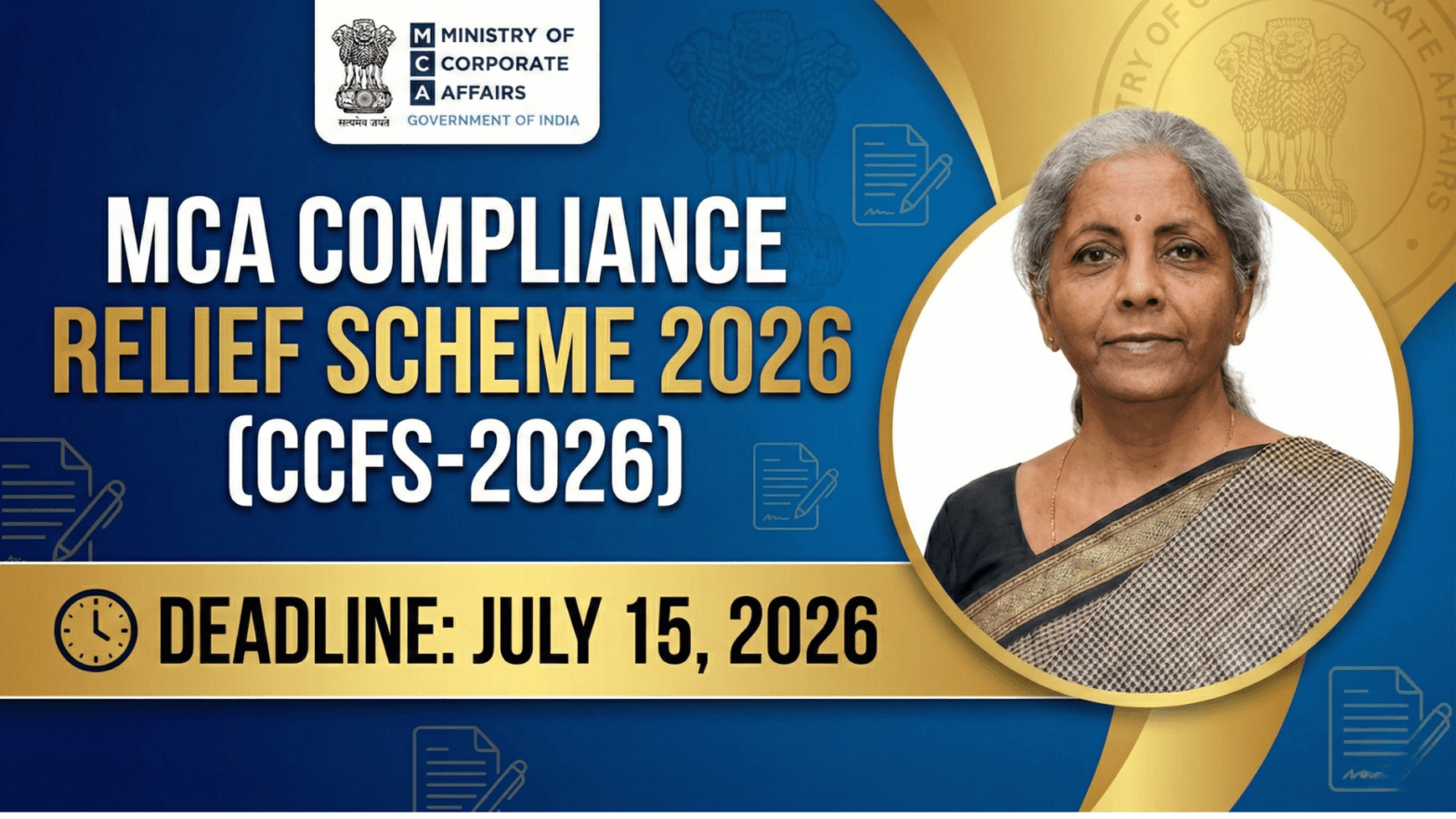
MCA Compliance Relief Scheme 2026 Deadline: If your company has fallen behind on its annual filings with the Registrar of Companies (ROC), the Ministry of Corporate Affairs (MCA) has just offered a rare lifeline. Introduced via General Circular No. 01/2026 on February 24, 2026, the Companies Compliance Facilitation Scheme, 2026 (CCFS-2026) is a one-time amnesty window.
For three months, defaulting companies can clear their pending compliance backlog at drastically reduced fees while securing legal immunity. Think of it as a brief “reset button” for your corporate compliance. However, this window closes firmly on July 15, 2026.
Here is everything you need to know about CCFS-2026 and how TrustLink India can help you navigate it.
The CCFS-2026 is a structured relief initiative under the Companies Act, 2013. In the past, India has seen similar amnesties (like CLSS 2010 and CFSS 2020), but this year’s scheme is highly targeted. It offers three specific tracks to help companies either regularize their status, pause operations affordably, or exit the registry cleanly.
| Relief Track | Normal Penalty/Fee | CCFS-2026 Concession | Total Savings |
| Pending Annual Filings | Full additional fees (₹100/day, uncapped) | 10% of additional fees | 90% waiver on late fees |
| Dormant Status (MSC-1) | Standard filing fee | 50% of normal fee | 50% savings |
| Voluntary Strike-Off (STK-2) | Standard filing fee | 25% of filing fees | 75% savings |
This track will benefit the vast majority of non-compliant active businesses. Any overdue forms—including MGT-7, MGT-7A, AOC-4, AOC-4 CFS, ADT-1, FC-3, FC-4, and even legacy forms from the 1956 Act (like Form 20B/23AC)—are eligible. You will only pay 10% of the accumulated late fees.
The Math: If you missed filing MGT-7 and AOC-4 for five years, your standard additional fees would amount to roughly ₹3.65 lakh. Under CCFS-2026, your liability drops to just ₹36,500.
If your startup is on pause, or you are running a promoter-owned shell or holding company with zero accounting transactions, you can officially declare it “dormant” under Section 455. The scheme cuts the MSC-1 application fee in half. Once dormant, your only obligation is filing a single Form MSC-3 annually.
If a business is entirely defunct with no liabilities, it is safer to shut it down voluntarily rather than waiting for the ROC to force a compulsory strike-off (which brings criminal liabilities for directors). Filing Form STK-2 to officially dissolve the company now costs just 25% of the standard fee.
Eligible Entities:
Private Limited Companies and One Person Companies (OPCs).
Small Companies and MSMEs.
Foreign company branch offices (filing FC-3, FC-4).
Inactive or non-operational companies.
Companies with legacy defaults under the older Companies Act, 1956.
Excluded Entities:
Companies that have already received a final ROC strike-off notice.
Companies actively undergoing Corporate Insolvency Resolution Process (CIRP).
“Vanishing” companies or those under special regulatory scrutiny.
Entities that have already applied for MSC-1 (Dormant) or STK-2 (Strike-off) prior to the scheme.
Companies dissolved via amalgamation.
While the financial savings are massive, the legal protection is arguably the most valuable part of CCFS-2026. Filing under this scheme grants directors immunity from prosecution under Sections 92 and 137 of the Companies Act 2013 (which govern the defaults of annual returns and financial statements).
Timing is critical: This immunity is only valid if you file before an adjudicating officer issues a notice, or within 30 days of receiving one. If you wait until the notice matures past 30 days, the immunity is voided. This is why our experts at TrustLink India strongly advise filing in April rather than waiting for July.
Audit Your Backlog: Log into the MCA21 portal (V3) and clearly map out every single overdue form across all financial years.
Calculate the Fees: Determine your precise 10% additional fee liability using the MCA’s official fee calculator.
Compile Documentation: Gather all necessary paperwork, including signed audit reports, board resolutions, valid Digital Signature Certificates (DSC), and active Director Identification Numbers (DIN).
Submit via MCA21 V3: Ensure all linked filings (such as CSR-2 or the E-Auditor Report, where applicable) are attached correctly to AOC-4 before submission.
Archive the SRN: The Service Request Number (SRN) generated upon payment is your definitive proof of compliance and immunity. Keep it safe.
The MCA has made it explicitly clear that severe enforcement will begin immediately after July 15, 2026, for companies that fail to regularize their status. The consequences of inaction include:
Director Disqualification: Three consecutive years of missed filings will disqualify you from sitting on any company’s board for five years under Section 164(2).
Compounding Penalties: The ₹100/day penalty will resume in full, with no maximum cap.
Bank Account Freezes: Non-compliant companies will find it nearly impossible to maintain current accounts, secure loans, or renew overdraft limits.
Compulsory Strike-Off: The ROC will forcibly remove the company’s name, potentially attaching criminal liability to the promoters.
Profile: ABC Tech Solutions Pvt. Ltd. (MSME)
Default: Failed to file AOC-4 and MGT-7 for FY 2022-23 & FY 2023-24 (Total 4 forms).
Average Delay: ~700 days per form.
Cost WITHOUT CCFS-2026:
4 forms × ₹100/day × 700 days = ₹2,80,000 in late fees (plus standard fees and potential director penalties).
Cost WITH CCFS-2026:
Only 10% of the late fee applies = ₹28,000.
Result: A direct saving of ₹2.52 lakh, plus full immunity from prosecution.
Once you have used the scheme to wipe the slate clean, keep this standard timeline in mind to avoid future penalties.
| Form | Purpose | Standard Deadline |
| ADT-1 | Auditor Appointment | 15 days after the AGM |
| AOC-4 | Financial Statements | 30 days after the AGM |
| MGT-7 / 7A | Annual Return | 60 days after the AGM |
| DIR-3 KYC | Director KYC | September 30th annually |
1. Can Limited Liability Partnerships (LLPs) take advantage of CCFS-2026?
No. The CCFS-2026 scheme is exclusively for companies registered under the Companies Act, 2013 (and its predecessor, the 1956 Act). LLPs are not covered under this specific circular.
2. Is there a limit to how many years of backlogged filings I can clear?
There is no maximum cap on the number of default years. You can regularize all outstanding historical filings within this three-month window.
3. Will the July 15, 2026 deadline be extended?
The MCA has given no indication that this scheme will be extended. Historically, waiting for an extension is highly risky. Businesses should plan with the assumption that July 15 is a hard, absolute deadline.
4. Do I lose my legal immunity if I already received an adjudication notice?
You can still claim immunity only if you file your pending documents under the scheme within 30 days of receiving that specific adjudication notice. If the 30-day mark has passed, the immunity provision will not apply to you.
5. Do I strictly need a CA or CS to file under this scheme?
While it is not legally mandatory for every single step, navigating multi-year backlogs, linked V3 portal forms, and calculating exact liabilities can be highly complex. Professional guidance from experts at TrustLink India is strongly recommended to ensure you do not make technical errors that could void your immunity.
by Corporate Advisory, TRUSTLINK