Welcome to TRUSTLINK
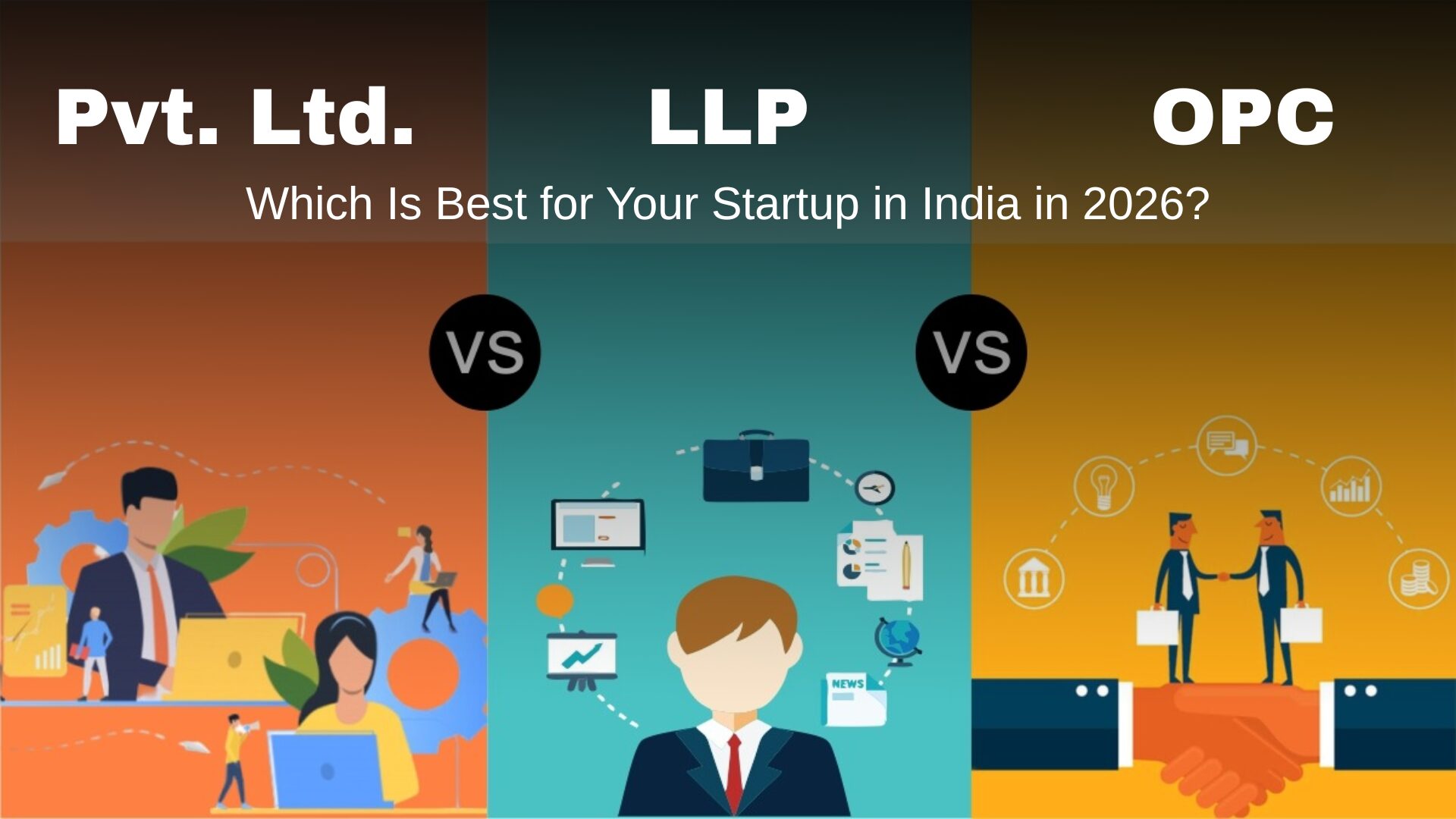
The absolute most devastating mistake a first-time founder can make in India has nothing to do with building the wrong product or hiring the wrong engineer. It is choosing the wrong legal structure on day one. Every week, we see brilliant teams of two register a One Person Company (leaving one founder legally off the cap table) or a highly scalable tech startup register an LLP, only to have their first term sheet rejected by Venture Capitalists who refuse to invest in partnerships. Your business structure dictates your taxes, your compliance costs, your personal liability, and your ability to raise capital. Choosing correctly is non-negotiable.
What is the best business structure for a startup in India?
For startups actively seeking venture capital or angel funding, a Private Limited Company is the only viable structure, offering scalable equity, ESOPs, and limited liability. If you are starting a professional services or consulting firm with a partner and will not need external equity funding, a Limited Liability Partnership (LLP) provides robust liability protection with significantly lower compliance and flexible profit sharing. For solo, bootstrapped founders wanting corporate credibility without a co-founder, an OPC (One Person Company) is ideal, though it cannot issue equity to external investors.
Table of Contents
The Master Comparison: Private Limited vs LLP vs OPC (2026)
Before diving into the legal mechanics of each entity, here is the definitive, side-by-side comparison of the three primary structures. Use this table as your ultimate quick-reference guide.
| Feature | Private Limited Company | Limited Liability Partnership (LLP) | One Person Company (OPC) |
| Minimum Members | 2 Shareholders, 2 Directors | 2 Designated Partners | 1 Shareholder, 1 Director (Can be same) |
| Maximum Members | 200 Shareholders | Unlimited | 1 Shareholder |
| Limited Liability | Yes (Limited to unpaid share capital) | Yes (Limited to capital contribution) | Yes (Limited to unpaid share capital) |
| Base Corporate Tax Rate | 22% or 25% (Can be 15% for new manufacturing) | 30% flat rate | 22% or 25% |
| VC / Investor Friendly | Extremely High (The global gold standard) | Extremely Low (VCs will not invest) | Zero (Cannot issue shares to investors) |
| Compliance Burden | High (Mandatory audits, board meetings, ROC filings) | Low (Audit only if turnover > ₹40L or capital > ₹25L) | Moderate (Audit mandatory, fewer board meetings) |
| Foreign Ownership | Permitted (Under FDI automatic route for most sectors) | Permitted (Under FDI automatic route for most sectors) | Permitted (Non-Resident Indians can form an OPC) |
| Ideal For | High-growth startups, tech product companies, VC-backed firms | Agencies, CAs, lawyers, architects, bootstrapped services | Solo consultants, freelance developers, single-founder brands |
The Private Limited Company (Pvt Ltd)
If you have ambitions to build the next Flipkart, Zomato, or a heavily funded SaaS platform, the Private Limited Company is your default answer. Governed by the Companies Act, 2013, it is an independent legal entity designed explicitly for scale, governance, and capital infusion.
Best Suited For
- Tech startups, product-based businesses, and highly scalable D2C brands.
- Teams of two or more founders looking to distribute equity accurately.
- Any business that plans to raise capital from Angel Investors, Venture Capitalists, or Private Equity firms within the next 3 to 5 years.
The Pros
- The Global VC Standard: Venture Capitalists buy equity (shares). A Private Limited Company is the only structure here that efficiently issues Preference Shares (CCPS), which VCs require to protect their investments. If you pitch a VC with an LLP, their first condition will be: “Convert to a Pvt Ltd, and then we will talk.”
- Absolute Limited Liability: The company is a separate “person” in the eyes of the law. If your startup goes bankrupt with ₹5 Crores in debt, the banks cannot touch your personal savings, your home, or your car (unless you gave a personal guarantee).
- Perpetual Succession: The company outlives you. If a founder resigns, retires, or passes away, the company continues to exist uninterrupted. The shares are simply transferred.
- ESOP Capability: You can create Employee Stock Ownership Plans (ESOPs) to attract top-tier engineering and leadership talent by offering them a piece of the company’s future value.
The Cons
- High Compliance Burden: The Ministry of Corporate Affairs (MCA) heavily regulates Pvt Ltd companies to protect investors and the public. You cannot legally take a single rupee out of the company without formal accounting documentation.
- Higher Maintenance Cost: You must hire a practicing Chartered Accountant (CA) or Company Secretary (CS) to maintain your books, conduct audits, and file annual returns. Expect to spend ₹20,000 to ₹40,000 annually just to keep the entity compliant, regardless of whether you make a profit.
Compliance Overview
Running a Private Limited Company means adhering strictly to the MCA calendar. Key annual filings include:
- Form AOC-4: Filing of the company’s audited financial statements, balance sheet, and profit & loss account (due within 30 days of the AGM).
- Form MGT-7: The annual return containing details of shareholders, directors, and board meetings held during the year (due within 60 days of the AGM).
- Form ADT-1: Appointment of the statutory auditor.
- Mandatory Board Meetings: You must hold a minimum of four board meetings per financial year, with no more than 120 days between consecutive meetings.
- Annual General Meeting (AGM): Mandatory yearly meeting of shareholders to adopt financials and declare dividends.
Who Should NOT Choose Pvt Ltd
Do not register a Private Limited Company if you are starting a small lifestyle business, a local retail shop, or a freelance agency with your friend where you plan to split the profits at the end of every month. The compliance costs and strict dividend distribution taxes will eat your margins alive.
The Limited Liability Partnership (LLP)
The Limited Liability Partnership, governed by the LLP Act of 2008, is the perfect hybrid. It offers the structural simplicity and flexible profit-sharing of a traditional partnership, but wraps it in the protective armor of limited liability found in a corporate structure.
Best Suited For
- Professional services firms (Chartered Accountants, lawyers, architects).
- Digital marketing agencies, creative studios, and consultancy collectives.
- Bootstrapped co-founders who want to run a profitable, cash-generating business and divide the profits without heavy corporate red tape.
The Pros
- Extremely Low Compliance: Unlike a Private Limited Company, an LLP is not required to conduct a statutory audit of its accounts unless its annual turnover exceeds ₹40 Lakhs OR its total capital contribution exceeds ₹25 Lakhs. If you are below these thresholds, your annual compliance is incredibly cheap and simple.
- Flexible Profit Extraction: In a Pvt Ltd, transferring profits to founders involves salaries (taxed as income) or dividends (which face complex taxation). In an LLP, the designated partners can draw remuneration and share profits directly, based entirely on the terms of the LLP Agreement.
- No Mandatory Board Meetings: You are not legally required to hold four board meetings a year or maintain heavy minute books. The partners manage the business as they see fit.
- Pass-Through-Like Taxation Simplicity: While the LLP itself pays a flat corporate tax, the share of profit received by the partners is completely exempt from tax in their personal hands under Section 10(2A) of the Income Tax Act.
The Cons
- A Hard Dealbreaker for Venture Capital: VCs simply do not invest in LLPs. LLPs do not have “shares,” they have “capital contributions.” You cannot easily issue complex equity instruments like compulsorily convertible preference shares. If you want VC money, an LLP is a dead end.
- Higher Base Tax Rate: As we will explore in the tax section, LLPs pay a flat 30% tax rate, missing out on the concessional 22% and 15% tax slabs available to domestic Private Limited Companies.
Who Should NOT Choose LLP
Founders building capital-intensive startups (like hardware, deep-tech, or heavy e-commerce) that require millions of dollars in external funding. Also, avoid LLPs if you plan to aggressively distribute equity (ESOPs) to employees, as the LLP structure makes this administratively agonizing.
The One Person Company (OPC)
Introduced in the Companies Act, 2013, the OPC was designed to kill the traditional “Sole Proprietorship.” It allows a single individual to incorporate a legitimate company, acting as both the sole shareholder and the sole director.
Best Suited For
- Solo founders, top-tier freelancers, and single-person e-commerce sellers.
- Bootstrapped entrepreneurs who want the corporate prestige of adding “Private Limited” to their brand name, but do not have (or want) a co-founder.
The Pros
- Complete Independence: You make 100% of the decisions. You own 100% of the equity. You do not need to dilute your control or bring in a namesake co-founder just to meet a statutory minimum.
- Corporate Limited Liability: Unlike a sole proprietorship where your personal assets are fully exposed to business debts, an OPC is a separate legal entity. Your risk is capped at your investment in the company.
- Fewer Compliance Hurdles than a Pvt Ltd: An OPC is exempt from holding Annual General Meetings (AGMs). You also only need to hold two board meetings a year (one in each half of the calendar year), as opposed to four.
The Cons and the “Mandatory Conversion” Myth
If you have been Googling OPC structures, you have likely read this widely circulated disadvantage: “An OPC must mandatorily convert to a Private Limited Company if its turnover exceeds ₹2 Crore or its paid-up capital exceeds ₹50 Lakh.”
Correction: This is an outdated myth. The Ministry of Corporate Affairs (MCA) abolished this rule in the Companies (Incorporation) Second Amendment Rules, 2021. Today, in 2026, an OPC can grow to ₹50 Crores in revenue and still remain an OPC. You are never forced to convert based on revenue. You can also voluntarily convert an OPC into a Private Limited Company at any time without any mandatory waiting periods.
- The Real Con — Zero External Equity: Because an OPC can legally only have ONE shareholder, you cannot sell a 10% stake to an angel investor. The moment you want to issue equity to a second person, you must convert the OPC into a Private Limited Company.
- Mandatory Nominee Requirement: You cannot open an OPC completely alone. You must legally appoint a “Nominee” (usually a spouse or parent) who will take over the company in the event of your death or incapacitation.
Who Should NOT Choose OPC
Any founder who plans to raise external funding within the first 12 months. If you know you will need investors, do not waste time and money registering an OPC only to pay a CA to convert it to a Private Limited Company six months later. Just start with a Private Limited Company and appoint a family member as a silent 1% shareholder/director until you find a co-founder.
The Ultimate Decision Framework: Which One Is Right for You?
Still unsure? Find your exact situation below and follow the direct recommendation.
1. “I am building a tech startup and plan to pitch to Angel Investors and VCs.”
👉 Choose: Private Limited Company.
This is non-negotiable. Institutional investors mandate a Pvt Ltd structure for its stringent governance, ability to issue preference shares, and clear exit mechanisms.
2. “I am starting a digital marketing/consulting agency with my friend. We will fund it ourselves and split the profits.”
👉 Choose: Limited Liability Partnership (LLP).
You do not need VC money, and you do not want the headache of massive compliance. An LLP gives you the legal safety to sign enterprise client contracts while allowing you to easily withdraw profits as partner remuneration.
3. “I am a solo founder launching a D2C brand. I am self-funding it and want to protect my personal savings.”
👉 Choose: One Person Company (OPC).
An OPC gives you the credibility of a corporate entity for vendor negotiations and completely shields your personal assets from business liabilities, without forcing you to find a fake co-founder.
4. “I have a foreign co-founder, or I am building a subsidiary of a foreign company.”
👉 Choose: Private Limited Company.
While FDI is allowed in LLPs under the automatic route for most sectors, opening a corporate bank account and managing RBI/FEMA compliance for foreign equity is exponentially smoother in a Private Limited structure, which foreign banks and investors natively understand.
5. “I am starting an NGO or a social enterprise where all profits go back into the cause.”
👉 Choose: Section 8 Company.
Neither Pvt Ltd, LLP, nor OPC is right for you. You need a specialized corporate structure (Section 8 Company) or a Public Charitable Trust to accept donations, apply for CSR grants, and receive tax exemptions under Section 12A/80G.
6. “I am a solo freelancer currently operating as a Sole Proprietorship, making ₹40 Lakhs a year.”
👉 Choose: Stay as a Sole Proprietorship (for now).
Unless you are signing contracts that expose you to massive legal liability, upgrading to an OPC for ₹40 Lakhs a year will simply increase your CA bills. Wait until your revenue scales or your clients demand corporate incorporation.
The Tax Comparison: How Much Will the Government Take in 2026?
A massive factor in your decision must be the corporate tax structure. The Indian government heavily incentivizes Private Limited Companies over LLPs through concessional tax rates.
Private Limited Company and OPC Taxation
The base tax rate for a Private Limited Company (and an OPC) depends on the regime you opt into:
- Standard Regime: 25% (Applicable if your previous year’s turnover was up to ₹400 Crores).
- Concessional Section 115BAA: 22%. Any domestic company can opt for this lower rate, provided they surrender certain specialized deductions (like accelerated depreciation or SEZ holidays). With applicable surcharge (10%) and cess (4%), the effective tax rate rests around 25.17%.
- New Manufacturing (Section 115BAB): 15%. If you incorporate a new manufacturing company, you can unlock an incredibly lucrative 15% base tax rate (effective ~17.16%).
- Minimum Alternate Tax (MAT): For 2026, the MAT rate has been reduced to 14% (down from 15%) on book profits, ensuring companies claiming heavy deductions still pay a baseline tax. (Note: Companies opting for the 115BAA 22% rate are exempt from MAT).
Limited Liability Partnership (LLP) Taxation
LLPs do not get to enjoy the 22% or 15% concessional rates.
- Standard Rate: LLPs pay a flat 30% tax on their net profits.
- Surcharge: If the LLP’s income exceeds ₹1 Crore, a heavy 12% surcharge is added.
- Alternate Minimum Tax (AMT): Similar to MAT, LLPs are subject to an AMT of 18.5%.
- The Silver Lining: While the corporate tax rate is higher, the remuneration and interest on capital paid to partners are treated as deductible business expenses for the LLP (up to specified limits under Section 40(b)), significantly reducing the taxable profit.
The Tax Verdict: If you are building a highly profitable, high-revenue company and intend to retain the cash inside the business for growth, a Private Limited Company is far more tax-efficient due to the 22% base rate. If you intend to draw out all the profits as founder salaries, an LLP offers a simpler route.
Frequently Asked Questions (FAQ)
Here are the most common rapid-fire questions founders ask our legal team at TrustLink India.
Q: Can an LLP raise venture capital funding?
A: Practically, no. While it is not strictly illegal, Venture Capitalists demand equity, specifically Compulsorily Convertible Preference Shares (CCPS). LLPs do not have a share capital structure; they rely on partnership capital contributions. VCs will categorically require you to convert the LLP into a Private Limited Company before issuing a term sheet.
Q: What is the minimum capital required to start a Pvt Ltd or OPC in India?
A: Zero. The MCA removed the minimum paid-up capital requirements for both Private Limited Companies and OPCs years ago. You can legally incorporate a company today with an authorized and paid-up capital of just ₹1,000, though starting with ₹1,00,000 is the standard professional recommendation.
Q: Can I convert my OPC to a Pvt Ltd later if I find an investor?
A: Yes, absolutely. Following the 2021 amendments, an OPC can voluntarily convert into a Private Limited Company at any time. You simply need to appoint one additional director and one additional shareholder, alter your Memorandum of Association, and file Form INC-6 with the ROC.
Q: Do I need a commercial office space to register these entities?
A: No. You can legally register a Private Limited Company, LLP, or OPC using your residential home address in India as the official Registered Office. You will just need to provide a recent utility bill and a No Objection Certificate (NOC) from the owner of the property.
Q: Which structure requires the most compliance?
A: The Private Limited Company has the heaviest compliance burden. It requires mandatory annual statutory audits by a CA, a minimum of four board meetings annually, AGM filings, and stringent maintenance of statutory registers, regardless of whether the company made a profit or had zero revenue.
Q: If my startup fails, am I personally responsible for a Private Limited company’s debts?
A: No, provided you did not engage in outright fraud. Because of the “limited liability” feature, the company’s financial failures stop at the corporate level. Your personal bank accounts and assets are fully protected. (Exception: If you personally co-signed or guaranteed a bank loan for the business, the bank can pursue you).
Build Your Startup’s Foundation with TrustLink India
Your business structure is the chassis upon which your entire company is built. If you choose the wrong one, you will spend months of your life and lakhs of rupees paying lawyers to untangle, convert, and restructure your entity when you should be focused on building your product and closing sales.
At TrustLink India, our specialized team of Company Secretaries, Chartered Accountants, and startup attorneys remove the guesswork from incorporation. Whether you need a VC-ready Private Limited Company, a low-compliance LLP for your agency, or an OPC for your solo venture, we handle the end-to-end MCA filing, name approvals, and post-incorporation tax setups seamlessly.
Don’t let legal ambiguity stall your launch. Contact TrustLink India today, and let’s get your startup registered the right way.