Welcome to TRUSTLINK

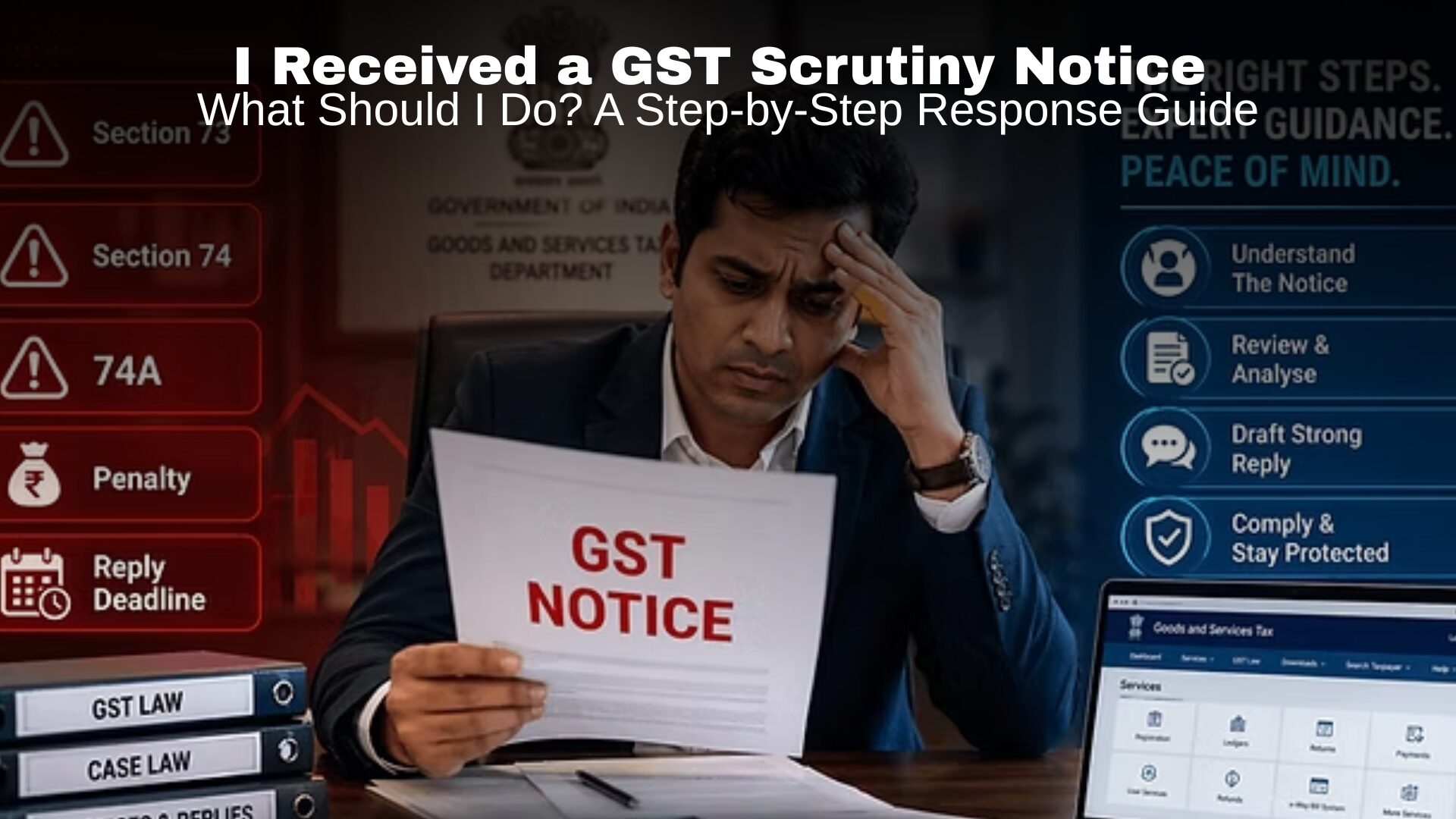
GST scrutiny notice: Take a deep breath. Seeing an email or SMS stating you have received a notice from the Goods and Services Tax Network (GSTN) can make your heart race, but rest assured receiving a scrutiny notice does not mean you are accused of a crime. In 2026, the vast majority of these notices are automated, system-generated alerts triggered by a simple mismatch in data between different returns. You are not inherently in trouble; the tax department simply needs you to explain a discrepancy.
What is a GST scrutiny notice, and why did I receive it?
A GST scrutiny notice is an official communication from the tax department flagging discrepancies in your filed returns, such as a mismatch between your claimed Input Tax Credit (ITC) and your suppliers’ declarations. You must respond online via the GST portal within the stipulated deadline (usually 15 to 30 days) with supporting documents to clarify the data, pay any accidental shortfalls, and close the case.
Table of Contents
Decoding Your Notice: Types of GST Notices Explained
The first step in reducing your anxiety is understanding exactly what kind of letter you just received. The GST Act uses specific sections for different types of defaults. Here is a quick breakdown to help you identify your notice.
| Notice Type | Governing Section | What It Means | Immediate Action Required |
| GSTR-3A | Section 46 | Default in filing your regular GST returns (GSTR-1 or GSTR-3B). | File the pending returns within 15 days along with late fees. |
| ASMT-10 | Section 61 | A Section 61 GST notice for return scrutiny. The system found a data mismatch. | File a detailed explanation in Form ASMT-11 within 30 days. |
| DRC-01 / 01A | Section 73 & 74 | Intimation of tax demand (Section 73 for non-fraud; Section 74 for fraud). | Reply via Part B of DRC-01A or prepare for formal litigation. |
| CMP-05 | Section 10 | Show cause notice to a Composition Dealer for violating scheme rules. | Reply within 15 days explaining why you are eligible for the scheme. |
The 7-Step Action Plan: GST Scrutiny Notice India How to Respond
If you received an ASMT-10 (Scrutiny Notice under Section 61), follow this exact, step-by-step roadmap to resolve the issue cleanly and professionally without escalating to a formal tax demand.
Step 1: Read the Notice Carefully and Extract Key Data
Do not panic-read. Sit down with a highlighter (or open the PDF carefully) and identify four critical pieces of information:
- The Tax Period: Which financial year and month is under scrutiny? (e.g., FY 2023-24).
- The Discrepancy Amount: How much tax is the officer questioning?
- The Core Issue: Is it an ITC mismatch? A turnover difference between your GSTR-1 and your Income Tax Return?
- The Document Identification Number (DIN): Ensure the notice has a valid DIN. In 2026, any communication from the tax department without a system-generated DIN is legally invalid.
Step 2: Do NOT Ignore the Deadline
The clock starts ticking the moment the notice is issued on your portal. For a standard Section 61 GST notice, you have exactly 30 days to respond. Ignoring this deadline is the worst possible mistake. If you fail to reply, the officer assumes you agree with the discrepancy and will automatically escalate the matter to a Section 73 or 74 Show Cause Notice, initiating a formal tax demand. If you need more time to gather documents, file a formal written request on the portal asking for an extension of 15 days.
Step 3: Gather the Required Documents
Your response will only be accepted if it is backed by documentary evidence. Depending on the nature of the notice, pull the following from your archives:
- Copies of your GSTR-1, GSTR-3B, and GSTR-9 for the relevant period.
- The GSTR-2A or GSTR-2B downloads for the disputed months.
- Tax invoices, debit notes, and credit notes related to the flagged transactions.
- Bank statements proving you paid the supplier within 180 days (crucial for ITC disputes).
- E-way bills and delivery challans proving the actual movement of goods.
Step 4: Reconcile Your Returns with Your Books
Before you write a single word of your reply, you must find the mathematical truth. Conduct a thorough reconciliation. Compare your internal accounting software ledgers against what was actually filed on the GST portal. You must identify exactly why the mismatch occurred. Was it a clerical error where a zero was added? Did a vendor file their return late? Did you claim an invoice twice by mistake? Finding the root cause is the entire foundation of your defense.
Step 5: Draft a Professional, Factual Reply
When preparing the GST notice reply format India, leave emotion out of it. The tax officer is evaluating facts, not excuses. Your draft must be structured, polite, and highly specific.
- Start with the notice reference number, date, and your GSTIN.
- Address each discrepancy point-by-point exactly as they are listed in the notice.
- State the facts clearly (e.g., “The mismatch of ₹45,000 in ITC occurred because supplier XYZ filed their GSTR-1 in the subsequent month…”).
- Reference the specific documents you are attaching to prove your point.
- If you made a genuine mistake, admit it. State that you have voluntarily paid the differential tax along with the applicable interest under Section 50, and attach the DRC-03 payment challan.
Step 6: Respond on the GST Portal (Step-by-Step Navigation)
In 2026, practically all GST scrutiny responses are handled online. Do not mail a physical letter unless specifically requested. Here is exactly how to upload your ASMT-11 reply:
- Log in to the official GST Portal (
www.gst.gov.in) with your valid credentials. - Navigate to Services > User Services > View Additional Notices and Orders.
- Locate the specific notice in the list and click the View hyperlink.
- On the Case Details page, click on the Replies tab.
- Click Add Reply.
- A form will open. Enter your drafted explanation in the text box.
- Click Choose File to upload your supporting documents (merge your invoices and reconciliation sheets into compressed PDF files).
- Check the verification box, select your Authorized Signatory, and submit using either EVC (OTP) or DSC (Digital Signature Certificate).
Step 7: Follow Up and Document Everything
Once submitted, the status will change to “Reply furnished, Pending for order by tax officer.” Download the acknowledgment receipt. If the officer is satisfied with your explanation, they will issue an ASMT-12, officially dropping the proceedings and closing the scrutiny. Save this closure order safely—it is your permanent proof that the tax period was successfully cleared.
What Happens if You Fail to Respond?
When business owners bury their heads in the sand, routine administrative checks turn into severe legal nightmares. If you completely ignore a scrutiny notice or demand order, the GST department is legally empowered to take severe actions:
- Escalation to Formal Demand: An unanswered Section 61 notice automatically transforms into a Section 73 (non-fraud) or Section 74 (fraud) Show Cause Notice, which carries heavy penalties.
- Best Judgment Assessment (Section 62): If you received a notice for not filing returns and you ignore it, the officer will assess your tax liability based on their own estimates and data, which is always aggressively high.
- Bank Account Attachment: Under Section 83, to protect government revenue, the Commissioner can provisionally attach your business bank accounts, freezing your working capital overnight.
- Cancellation of GST Registration: Continuous non-compliance will lead to the suspension and eventual cancellation of your GSTIN, rendering it illegal for you to issue tax invoices or operate your business.
- Arrest Provisions (Section 132): While rare and reserved for extreme cases of outright fraud (like operating fake invoice syndicates exceeding ₹2 Crores), the GST Act does contain provisions for prosecution and imprisonment.
4 Common Reasons for GST Scrutiny Notices (And How to Fix Them)
Most notices stem from four common red flags triggered by the GSTN algorithm. Here is how to handle each one.
1. Mismatch Between GSTR-1 and GSTR-3B
- The Issue: Your GSTR-1 (sales details) shows a tax liability of ₹10 Lakhs, but your GSTR-3B (summary return where you pay the tax) only shows ₹8 Lakhs. The government wants the missing ₹2 Lakhs.
- The Solution: Reconcile the two returns. If GSTR-1 was wrong (e.g., a typo), explain the clerical error and show that the correct tax was paid in 3B. If 3B was wrong and you short-paid the tax, you must immediately pay the ₹2 Lakhs difference via Form DRC-03, along with 18% interest, and submit the challan in your reply.
2. ITC Claimed in 3B Exceeds GSTR-2A/2B
- The Issue: You claimed ₹5 Lakhs in Input Tax Credit in your GSTR-3B, but the portal (GSTR-2B) only reflects ₹3 Lakhs because your suppliers failed to upload their invoices.
- The Solution: Provide a detailed invoice-level reconciliation. Attach purchase invoices, proof of receipt of goods (e-way bills), and bank statements proving you paid the supplier. The burden is on you to prove the purchase was genuine.
3. High ITC Claims Relative to Turnover
- The Issue: Your business is showing massive purchases and very few sales, leading to a massive accumulation of ITC, which triggers anti-evasion algorithms.
- The Solution: Explain the business rationale. Perhaps you are a seasonal business stocking up inventory for the festive season, or a new factory buying heavy machinery. Provide ledgers and stock registers to prove the ITC is legitimate and backed by physical assets.
4. Delayed or Missed Filings
- The Issue: You filed returns past the due date but did not pay the mandatory late fees or interest on delayed tax payments.
- The Solution: The system is unforgiving regarding interest. Calculate the exact interest owed under Section 50 for the delayed days, pay it via DRC-03, and attach the proof of payment to close the matter.
When to Stop Googling and Hire a GST Litigation Expert
Handling a simple timing mismatch for a few thousand rupees is something an organized accountant can manage. However, you must hire a professional in GST litigation India immediately if:
- The disputed tax amount threatens your company’s cash flow.
- The notice is issued under Section 74, alleging fraud, willful misstatement, or suppression of facts.
- The officer rejects your initial ASMT-11 reply and issues a Show Cause Notice (SCN).
- You are summoned for a personal hearing.
Tax officers are bound by strict legal procedures. A specialized litigation consultant knows how to challenge the jurisdiction of the notice, invoke limitation periods, and leverage recent High Court rulings to get aggressive tax demands dropped entirely.
Frequently Asked Questions (FAQ)
Q: What is the difference between a GST notice and a GST demand?
A: A GST notice (like ASMT-10) is a preliminary inquiry asking for an explanation regarding a discrepancy. A GST demand (like a final order under Section 73/74) is a legally binding order establishing that you owe a specific amount of tax, interest, and penalty to the government.
Q: Can I reply to a GST notice myself?
A: Yes, business owners can legally draft and submit their own replies via the GST portal. However, for complex mismatches or notices alleging tax evasion, it is highly recommended to use a CA or a tax lawyer to ensure the response uses the correct legal terminology and statutory references.
Q: What is the time limit to respond to a Section 61 notice?
A: Under Section 61 of the CGST Act, you must submit your explanation in Form ASMT-11 within 30 days of receiving the ASMT-10 scrutiny notice. If you require more time, you can submit a written request to the proper officer for an extension of up to 15 days before the initial deadline expires.
Q: Will I have to pay a penalty if I receive a scrutiny notice?
A: Not necessarily. If you successfully explain the discrepancy with supporting documents, no penalty is levied, and the proceedings are dropped. If the notice highlights a genuine error where you short-paid tax, you will generally only have to pay the differential tax and applicable interest, provided you do so before it escalates to a formal demand.
Q: How do I know if my GST notice reply was accepted?
A: Once the tax officer reviews your Form ASMT-11 reply and finds the explanation satisfactory, they will issue an official order in Form ASMT-12. This form explicitly states that your reply has been accepted and the scrutiny proceedings for that specific period are closed.
Q: What happens if the GST portal is not allowing me to upload all my documents?
A: The GST portal has file size limits for attachments (usually 5MB per file, up to a maximum of 4 files). You must compress your PDF documents. If the volume of evidence is massive, upload a summary reconciliation statement online and explicitly state in your reply that the voluminous physical ledgers will be submitted to the officer’s jurisdiction manually upon request.
Resolve Your GST Notices Swiftly with TrustLink
A GST scrutiny notice is a test of your company’s internal compliance and record-keeping. While a calm, methodical approach is your best defense, navigating the complexities of the CGST Act, drafting legally sound replies, and attending personal hearings can distract you from running your business.
At TrustLink, our dedicated GST litigation wing specializes in intercepting notices before they escalate into crippling tax demands. Our senior CAs and tax advocates analyze your portal data, reconcile years of messy ledgers, draft ironclad ASMT-11 replies, and represent you directly before the tax authorities.
Do not let a system-generated mismatch turn into a frozen bank account. Contact TrustLink today for expert GST notice resolution and safeguard your business compliance.