Welcome to TRUSTLINK

Starting a business in India is an exciting milestone, and it all begins with one fundamental step: company registration. Whether you are launching an innovative startup, establishing a standard Private Limited Company, or setting up an Indian subsidiary of a foreign entity, having the correct documentation ready is crucial.
Many founders experience unnecessary delays during incorporation simply due to incomplete, mismatched, or outdated paperwork. Understanding exactly what the Ministry of Corporate Affairs (MCA) requires will significantly accelerate your approval process.
In this comprehensive guide, we will break down the exact documents you need to register a company in India and share expert tips to help you avoid common rejections.
Table of Contents
Why Is Accurate Documentation Crucial?
The Ministry of Corporate Affairs (MCA) mandates specific documents to strictly verify the identity, residential address, and eligibility of every proposed director and shareholder, as well as to confirm the legal occupancy of the registered office.
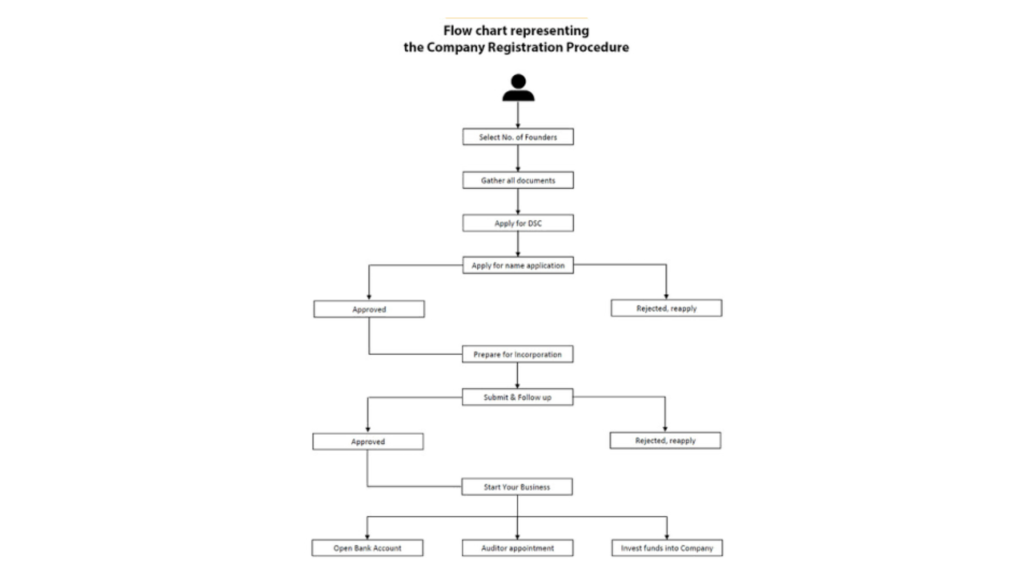
Submitting flawless documentation helps to:
- Ensure absolute legal compliance from day one.
- Authenticate the ownership and management structure.
- Prevent fraudulent or shell company registrations.
- Guarantee a much faster incorporation approval timeline.
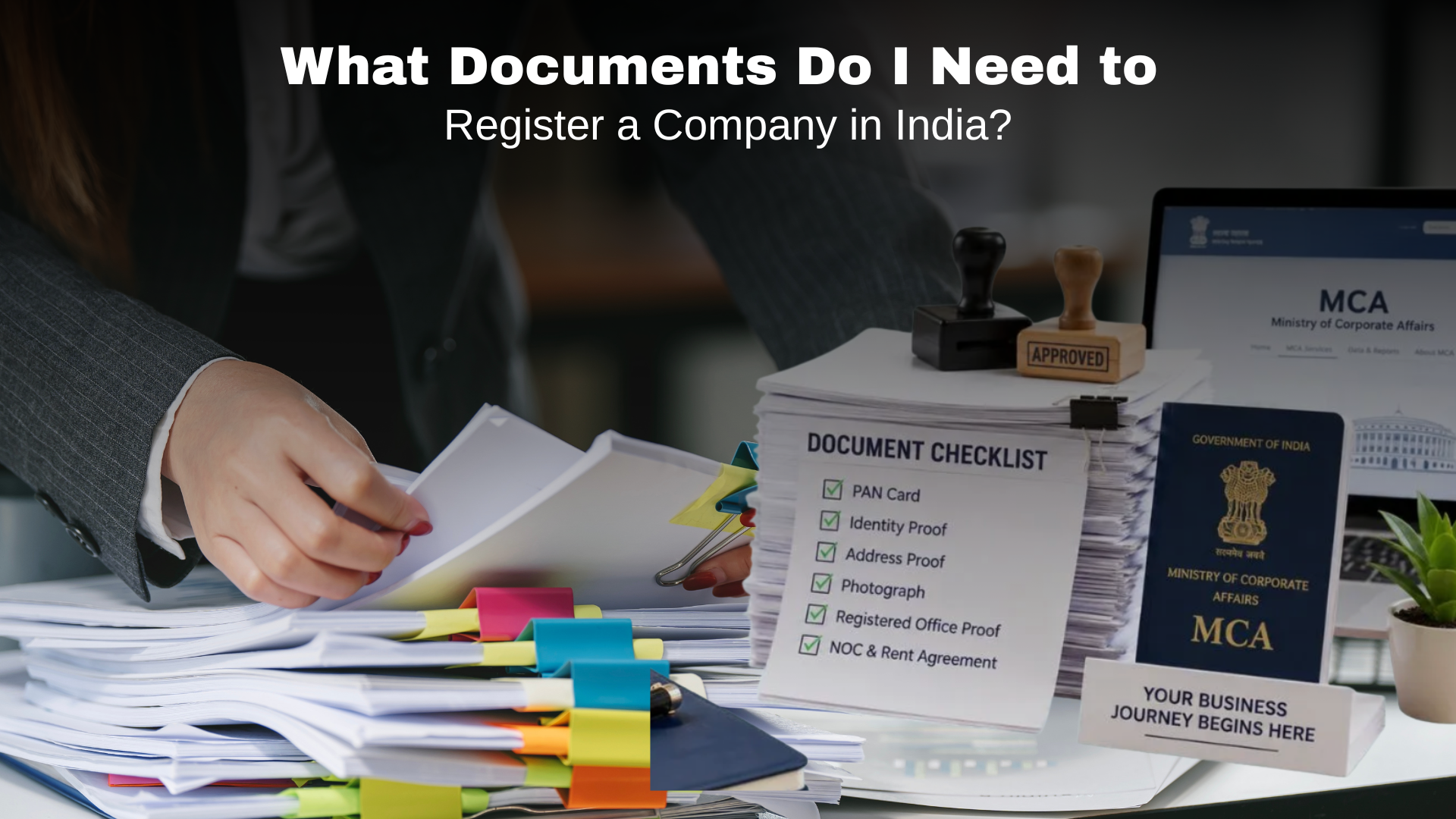
The Master Checklist: Documents Required for Company Registration
While minor requirements may shift based on your specific business structure, the following documents form the core requirements for registering a Private Limited Company, a Public Limited Company, or a Limited Liability Partnership (LLP) in India.
1. PAN Card of Directors and Shareholders
A Permanent Account Number (PAN) is legally mandatory for all Indian nationals acting as directors or shareholders.
- Requirements: A clear, self-attested copy of the PAN card. Crucially, the name printed on the PAN must match exactly with all other submitted documents.
2. Identity Proof of Directors
The MCA requires a government-issued ID to verify who is running the company. You may submit any one of the following:
- Aadhaar Card
- Passport
- Voter ID Card
- Driving License
Note: The ID proof must be valid, up-to-date, and completely legible.
3. Address Proof of Directors
You must provide recent proof of your current residential address.
- Accepted Documents: Bank Statement, Electricity Bill, Telephone/Mobile Bill, or Aadhaar Card (if it reflects the current address).
- Important Constraint: Utility bills and bank statements should generally not be older than two months from the date of filing.
4. Passport-Sized Photographs
Recent, clear passport-sized photographs of all proposed directors are required to process the Digital Signature Certificates (DSC) and Director Identification Numbers (DIN).
5. Registered Office Address Proof
Under the Companies Act, every business must maintain a registered office address in India.
- Accepted Proofs: Electricity Bill, Water Bill, Property Tax Receipt, or Gas Bill.
- Note: This utility bill must be recent and clearly display the complete address of the premises.
6. No Objection Certificate (NOC)
If the registered office is located in a rented space, or if the property is owned by someone else (even a family member or one of the directors), a signed No Objection Certificate (NOC) from the legal property owner is mandatory. This confirms the company has explicit permission to use the location as its official address.
7. Proof of Ownership or Rent Agreement
To support the registered office verification, you must also attach:
- A notarized Rent/Lease Agreement (if rented).
- Property ownership documents or sale deed (if owned).
Special Requirements for Foreign Directors
Foreign nationals are welcome to establish businesses and act as directors in India, but they face a stricter documentation process to ensure security and compliance.
Additional requirements include:
- Passport: Absolutely mandatory as the primary ID proof.
- Overseas Address Proof: A recent bank statement or utility bill from their home country.
- Notarization & Apostille: All identity and address proofs must be notarized and apostilled in their home country before submission to the MCA.
- Visa Details: A valid business visa (if they are present in India).
Foreign investors aiming to set up a Wholly Owned Subsidiary must also navigate specific Foreign Exchange Management Act (FEMA) and Reserve Bank of India (RBI) regulations.
4 Common Mistakes That Will Delay Your Registration
At TrustLink, we frequently see incorporation applications delayed by basic administrative errors. Avoid these common traps:
- Incorrect Name Matching: If your name is “Rahul Kumar Sharma” on your PAN, but just “Rahul Sharma” on your bank statement, the MCA will flag the discrepancy. Ensure exact name matches across all documents.
- Expired or Stale Documents: Submitting a telephone bill that is six months old will lead to instant resubmission requests. Stick to the two-month rule.
- Unclear Scanned Copies: Blurry photos, cut-off edges, or illegible text on scanned PDFs are a leading cause of rejection. Always upload high-resolution, clear scans.
- Faulty Registered Office Proof: Ensure the utility bill for the registered office matches the address mentioned in the NOC and rent agreement precisely.
How Long Does the Registration Process Take?
If your documentation is flawless and your proposed company name is unique and available, the actual company registration process can typically be completed within a few working days, subject to MCA processing times and workload. Preparing your documents perfectly in advance is the single biggest factor in achieving a fast approval.
Conclusion
Impeccable documentation is the bedrock of a smooth company registration process. Whether you are bootstrapping a new startup, formalizing a Private Limited Company, or launching a foreign subsidiary in India, ensuring your paperwork is accurate and complete will save you weeks of frustration and compliance headaches.
Before you file your SPICe+ forms, meticulously gather and verify your identity proofs, address documents, registered office bills, and NOCs. A well-organized dossier guarantees faster MCA approval, allowing you to focus on what actually matters: building your business.
If you need expert assistance with Company Registration in India, Private Limited Company Registration, Subsidiary Formation, or navigating MCA compliance, professional guidance from TrustLink can streamline the entire process, ensuring error-free filings from day one.
Frequently Asked Questions (FAQs)
Q: Can I register a company without a commercial physical office?
A: Yes. You can legally use a residential address as your registered office, provided you submit the necessary utility bill address proof and a signed NOC from the property owner.
Q: Is Aadhaar mandatory for company registration?
A: Aadhaar is widely used and highly recommended as identity and address proof for Indian nationals to speed up the process, though other valid government IDs (like a Voter ID or Passport) are also legally acceptable. However, a PAN card is strictly mandatory.
Q: Can a foreign national become a director in an Indian company?
A: Yes. Foreign nationals can be directors and shareholders in an Indian company, provided their passport and home country address proofs are properly notarized and apostilled according to international regulations.
Q: What is the most critical document required for company registration?
A: The PAN Card (for Indian nationals) is the foundational document. Alongside it, valid identity proof, recent residential address proof, and the registered office utility bill are the most essential documents required for incorporation.