Welcome to TRUSTLINK
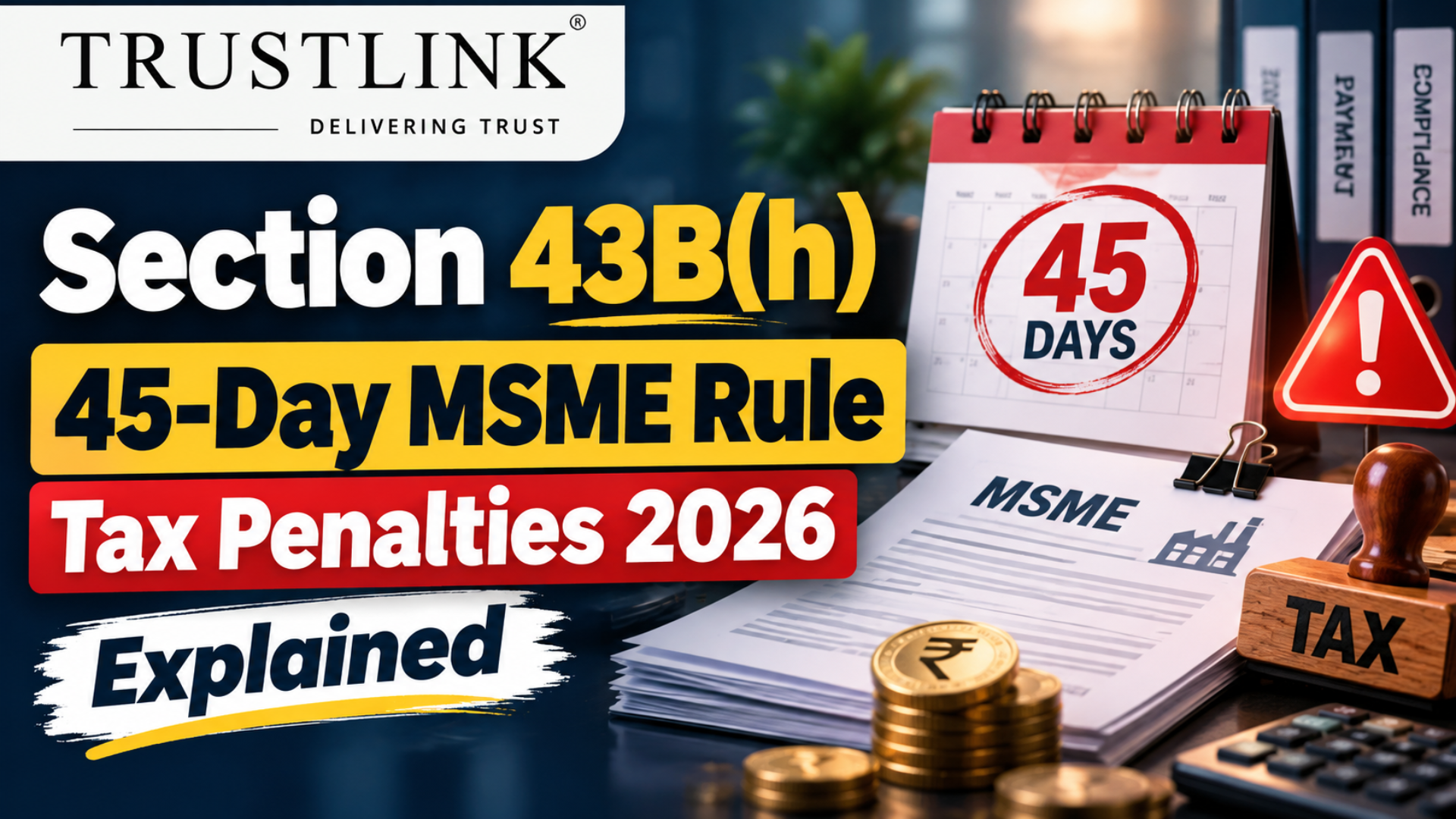
45 Days MSME Payment Rule: If you run a business in India, you purchase raw materials, inventory, or operational services on credit. In previous years, delayed vendor payments stayed between you and your supplier. If a supplier agreed to wait 90 or 120 days for payment, your tax auditor had no issue with it.
That changed with Section 43B(h) of the Income Tax Act. Under this rule, delaying payments to registered micro and small enterprises costs you far more than vendor trust. The Income Tax Department will disallow the entire purchase expense from your tax calculation, add that money directly to your net taxable profit, and tax you at your peak slab rate.
Table of Contents
What is the Section 43B(h) 45-day MSME rule?
Section 43B(h) is a statutory provision under the Income Tax Act, 1961, that disallows deductions for any payment owed to a registered Micro or Small enterprise if you do not pay them within the timeline specified in Section 15 of the MSMED Act, 2006. That payment window is 15 days if you have no written agreement, or up to a maximum of 45 days if you have an agreement in writing. If you miss this deadline and leave the dues unpaid at the end of the financial year, you cannot deduct the expense in that year. You can only claim the deduction in the year you actually pay the vendor.
The Legal Framework: Section 43B(h) and Section 15 of the MSMED Act
To protect yourself from sudden tax demands, you must understand how two separate laws intersect: the Income Tax Act, 1961, and the Micro, Small and Medium Enterprises Development (MSMED) Act, 2006.
Section 43B of the Income Tax Act specifies certain deductions that are allowable only on an actual payment basis. Clause (h) specifically targets amounts payable to micro and small enterprises.
Section 15 of the MSMED Act dictates the exact timeline for these payments:
- Scenario A (No written agreement): The payment must be cleared within 15 days from the day of acceptance of the goods or services.
- Scenario B (Written agreement in place): The buyer and supplier can agree on a credit period in writing, but this period cannot exceed 45 days from the date of acceptance. Even if your written contract specifies 60 or 90 days of credit, the law caps the valid credit term at 45 days.
+-------------------------------------------------------------------+
|               PAYMENT TIMELINES UNDER SECTION 15                  |
+-------------------------------------------------------------------+
| Written Contract?  | Maximum Permitted Window                     |
+--------------------+----------------------------------------------+
| NO                 | 15 days from delivery/acceptance             |
| YES                | Up to 45 days (contracts above 45 days void) |
+--------------------+----------------------------------------------+
Who Qualifies as a Micro or Small Enterprise?
Section 43B(h) does not apply to every vendor on your ledger. It strictly protects two categories: Micro Enterprises and Small Enterprises.
Medium enterprises, wholesale traders, and retail traders are excluded from the protection of Section 43B(h).
| Category | Investment in Plant & Machinery | Annual Turnover | Protected Under 43B(h)? |
| Micro Enterprise | Up to ₹1 Crore | Up to ₹5 Crore | Yes |
| Small Enterprise | Up to ₹10 Crore | Up to ₹50 Crore | Yes |
| Medium Enterprise | Up to ₹50 Crore | Up to ₹250 Crore | No |
| Traders (Wholesale/Retail) | Any | Any | No (Per Office Memo 1/4(1)/2021-P&G/Policy) |
If your vendor holds an Udyam Certificate showing their enterprise type as “Manufacturer” or “Service Provider” in the Micro or Small bracket, Section 43B(h) applies to every invoice they send you. If their certificate identifies them as a “Trader” (retail or wholesale), this specific rule does not apply.
How Section 43B(h) Works: A Concrete Financial Example
Consider a practical manufacturing scenario.
Your company, Apex Auto Components Private Limited, purchases raw sheet metal worth ₹20,00,000 from Rohit Steel Fabricators on February 10, 2026. Rohit Steel Fabricators is a registered Micro enterprise under the MSMED Act. You sign a formal purchase agreement specifying a 45-day payment term.
Under Section 15 of the MSMED Act, your payment deadline is March 27, 2026 (45 days from February 10).
Scenario 1: You Pay on March 25, 2026
You paid within 45 days, before the financial year ends on March 31.
- Accounting Treatment: The ₹20,00,000 is allowed as a business expense.
- Tax Impact: Nil penalty. Your taxable profit remains accurate.
Scenario 2: You Pay on April 15, 2026
You missed the March 27 deadline, but you paid before filing your Income Tax Return. Under standard Section 43B clauses, paying before the ITR due date protects your deduction. Clause (h) does not allow this concession.
- Accounting Treatment: Because the invoice was unpaid on March 31, 2026, and the 45-day limit was breached, the entire ₹20,00,000 is disallowed as a business expense for FY 2025-26.
- Tax Penalty: The tax department adds ₹20,00,000 back to your taxable net profit. At a corporate tax rate of 25.17% (base rate plus surcharge and cess), you will pay an additional tax of ₹5,03,400 for FY 2025-26.
- Recovery: You can claim the ₹20,00,000 deduction only in the subsequent year (FY 2026-27), because you paid in April 2026. Your cash flow takes a massive hit in the current year.
Scenario 3: The Compounding Interest Trap
The financial penalty does not stop at disallowed tax deductions. Under Section 16 of the MSMED Act, if you fail to pay the supplier within the prescribed period, you must pay compound interest on the monthly dues at three times the Bank Rate notified by the Reserve Bank of India.
Assuming the RBI bank rate is 6.5%, your penal interest rate is 19.5% compounded monthly. Under Section 23 of the MSMED Act, this penal interest is non-deductible; you cannot claim this interest payment as a business expense on your tax return.
Step-by-Step Vendor Audit Protocol for 2026
To avoid tax disallowances, your accounting team must execute a systematic audit of your accounts payable ledgers. Follow this operational checklist:
- Circulate an MSME Declaration Form to All Vendors: Send a circular to every supplier on your books requesting their current Udyam Registration details. Require them to state their enterprise category (Micro, Small, or Medium) and primary activity (Manufacturing, Services, or Trading).
- Verify Certificates on the Udyam Portal: Do not rely on email declarations alone. Enter the vendor’s 19-digit Udyam Registration Number on the government portal (
udyamregistration.gov.in) to confirm their registration status. Ensure their classification as Micro or Small matches their current filings. - Segregate Your Accounts Payable Master: Update your Enterprise Resource Planning (ERP) or accounting software (such as Tally or Zoho Books). Tag your vendors into three distinct groups:
- Group A: Micro and Small Manufacturers and Service Providers (Strict 45-day limit)
- Group B: Medium Enterprises (Standard contract terms)
- Group C: Traders (Standard contract terms)
- Enforce Formal Written Agreements: Replace informal purchase orders with written vendor agreements specifying a 45-day credit period. Without a written agreement, your payment deadline defaults to 15 days.
- Establish a 30-Day Alert System: Configure your accounting software to flag unpaid invoices at the 30-day mark. This gives your finance department a 15-day operational window to execute bank payments before the 45-day threshold is breached.
- Prioritize Outstanding Dues Before March 31: Review your aging summary on March 1 of each year. Direct your available working capital toward clearing all open invoices from Group A vendors before the financial year closes.
Common Myths Surrounding Section 43B(h)
- Myth 1: “If I pay before filing my ITR in October, I am safe.”Fact: This applies to other clauses under Section 43B (like statutory dues or bank interest), but the law explicitly excludes clause (h) from the extended ITR filing window. The invoice must be paid within 15 or 45 days, and cleared before March 31.
- Myth 2: “Traders can shut down our deductions under 43B(h).”Fact: The Ministry of MSME issued an official clarification stating that retail and wholesale traders are registered under Udyam solely for priority sector bank lending. They do not get the legal protections of Chapter V of the MSMED Act, which includes the 45-day payment rule and Section 43B(h).
- Myth 3: “If my vendor doesn’t print their Udyam number on the invoice, they can’t claim protection.”Fact: While suppliers are instructed to state their Udyam number on commercial documents, courts have held that an omission on an invoice does not strip away the supplier’s statutory status. The burden remains on the buyer to exercise due diligence.
Frequently Asked Questions (FAQ)
Q: Does Section 43B(h) apply to purchases of capital goods?
A: No, Section 43B(h) applies specifically to operational revenue expenditures claimed as deductions against business profits. Capital goods purchases are capitalized on your balance sheet and depreciated over time; the disallowance under Section 43B(h) targets the expenditure claimed in the Profit and Loss statement, not depreciation.
Q: Can a buyer agree to a 90-day credit period with a small supplier in writing?
A: You can write any term into a contract, but Section 15 of the MSMED Act overrides private contracts. The law states that the agreed period cannot exceed 45 days. Any contract clause specifying a credit term longer than 45 days is legally void, and the ceiling resets to 45 days.
Q: What happens if the goods delivered are defective?
A: If you notice defects in the delivered goods or services, you must formally submit an objection in writing to the supplier within 15 days of delivery. The payment clock stops until the supplier resolves the defect. The day the vendor remedies the defect becomes the new date of acceptance.
Q: Does Section 43B(h) apply if my business uses the presumptive taxation scheme under Section 44AD?
A: No. Section 44AD begins with a non-obstante clause (“Notwithstanding anything to the contrary contained in sections 28 to 43C…”). Because Section 44AD overrides Sections 28 through 43C, the disallowance provisions under Section 43B(h) do not apply to eligible businesses declaring profits under presumptive taxation.
Q: Are small enterprises registered under old regimes (Udyog Aadhaar or EM-II) protected?
A: No. Udyog Aadhaar and EM-II registrations expired years ago. Only suppliers holding a valid, active Udyam Registration Certificate under the current framework qualify for the protections of Section 43B(h).
Q: What is the penalty for not paying the 3x bank rate interest to the vendor?
A: If an MSME files a dispute on the MSME Samadhaan portal, the Facilitation Council will issue an order forcing you to pay the full interest amount. Furthermore, your statutory tax auditor must disclose your unpaid MSME interest liabilities in Form 3CD under the Tax Audit rules.
Q: Can my company dispute an MSME claim if the supplier registered on Udyam after delivering the goods?
A: Yes. The Supreme Court and High Courts have consistently ruled that Udyam registration is not retrospective. If a supplier was not a registered micro or small enterprise on the exact date they supplied the goods or services, they cannot claim benefits under Section 43B(h) for that specific transaction.
Stay Compliant with TrustLink
Managing Section 43B(h) calculations requires strict vendor tracking, contract restructuring, and clean book reconciliations. At TrustLink, our corporate compliance team reviews your accounts payable, validates your supplier Udyam records, and drafts compliant vendor agreements to safeguard your business from sudden tax disallowances. Contact TrustLink today to audit your vendor master and keep your tax liabilities under control.