Welcome to TRUSTLINK
Imagine pouring two years of your life and capital into building a revolutionary software startup. You proudly launch it, immediately registering your eye-catching logo to protect your brand. Six months later, your co-founder leaves, takes the entire source code, and launches an identical platform under a different name. You try to sue, only to realize a brutal truth: your logo was protected, but you never legally protected the actual product. You trademarked the paint job, but left the engine completely unguarded.
What is the difference between copyright, trademark, and patent in India?
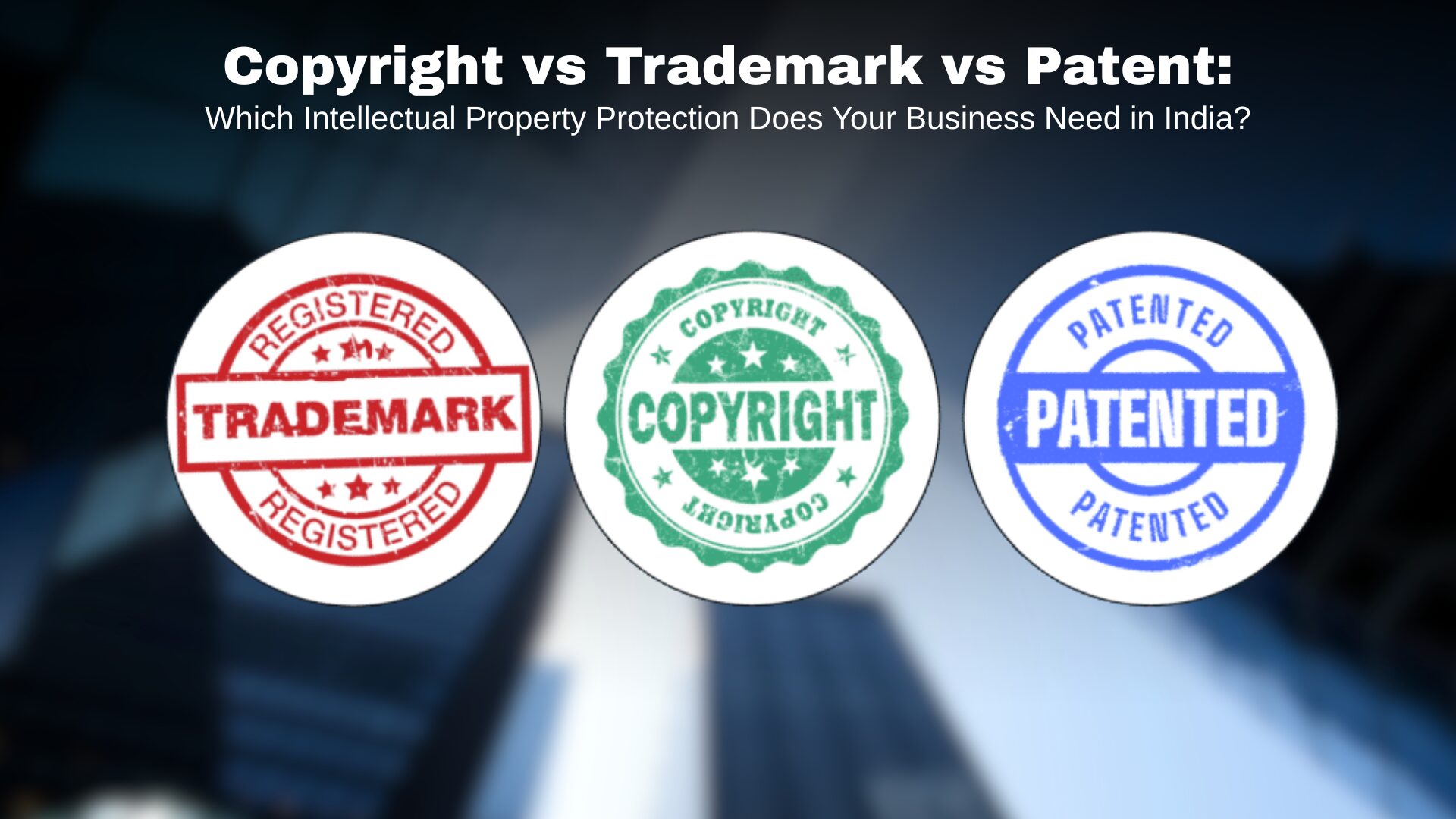
A copyright protects original creative works like software code, books, videos, and music from being copied. A trademark protects brand identifiers such as your company name, logo, and tagline to prevent market confusion. A patent protects novel, functional inventions, scientific processes, or unique hardware. In short: use a trademark to protect your brand name, a copyright to protect your creative content or software, and a patent if you invented a new physical product or method.
Table of Contents
The Core Differences: Copyright vs Trademark vs Patent India
When founders search for intellectual property protection India, they often use these terms interchangeably. However, the Trade Marks Registry, the Copyright Office, and the Patent Office operate under entirely different legal frameworks.
Here is the master comparison to clarify the patent vs trademark India confusion once and for all:
| Feature | Trademark | Copyright | Patent |
| What it primarily protects | Brand identity (Names, logos, slogans) | Creative expression (Software, art, literature, music) | Functional inventions (Machines, processes, chemicals) |
| Duration of Protection | 10 years (Renewable indefinitely) | Lifetime of author + 60 years | 20 years from filing (Non-renewable) |
| Registration Required? | Yes, highly recommended to enforce rights | No, automatic upon creation (but registration aids in court) | Yes, mandatory before public disclosure |
| Governing Law in India | Trade Marks Act, 1999 | Copyright Act, 1957 | Patents Act, 1970 |
| Base Govt. Fee (2026) | ₹4,500 (Startups/MSMEs) / ₹9,000 (Companies) per class | ₹500 (Software/Literary) to ₹5,000 (Films) | ₹1,600 (Startups/MSMEs) / ₹8,000 (Companies) |
| Approximate Time to Get | 6 to 12 months | 2 to 6 months | 2 to 4 years (unless expedited) |
1. Trademark: Protecting Your Brand Identity
Your brand is your reputation. If your product is excellent, competitors will naturally try to piggyback on your success by adopting similar names, color schemes, or logos to confuse your customers.
What It Protects
A trademark protects the commercial identifiers of your business. This includes:
- Brand Names: “TrustLink India”
- Logos and Symbols: The Nike Swoosh or the Apple silhouette.
- Taglines and Catchphrases: “Just Do It.”
- Non-Conventional Marks: Sound marks (the Netflix “Ta-dum”) and color marks (Cadbury’s specific shade of purple).
Trademarks are categorized into 45 different “Classes” under the Nice Classification system. For example, if you build software, you file under Class 9. If you open a restaurant, you file under Class 43.
Duration of Protection
A registered trademark in India is valid for 10 years. The beauty of a trademark is that it can be renewed indefinitely. As long as you keep paying the renewal fee every decade and actively use the mark in commerce, you can own it forever.
What Happens Without It
Consider the infamous “Burger Singh” vs “Burger King” disputes, or local instances where a popular city bakery finds three identical bakeries opening up across town. If you do not have a registered trademark (indicated by the ® symbol), you have to rely on the common law right of “passing off.” This means you must prove in court that you used the name first and that the copycat caused you financial damage—a long, expensive, and difficult legal battle. With a registered trademark, the burden of proof shifts heavily in your favor, and you can issue immediate cease-and-desist notices.
Who Needs It
Every single business that interacts with the public needs a trademark. Whether you are a sole proprietor selling handmade candles on Instagram, a B2B logistics firm, or a heavily funded SaaS startup, trademark registration India is the bare minimum intellectual property shield you must secure.
2. Copyright: Protecting Your Creative Expression
While trademarks protect who made the product, copyrights protect the actual product itself, provided it is a creative or artistic work.
What It Protects
Under the Copyright Act of 1957, copyright protects original works of authorship. In a business context, this covers:
- Software and Code: Source code, object code, and database structures are treated as “literary works” under Indian law.
- Marketing & Content: Website copy, blog posts, sales brochures, and ad graphics.
- Media: Podcasts, YouTube videos (cinematograph films), and original music (sound recordings).
- Design: Architectural blueprints and product manuals.
Crucial Rule: Copyright protects the expression of an idea, not the idea itself. If you write a book about a boy wizard, you own the copyright to those specific words and characters. You do not own the general idea of “magic schools,” which is why other authors can still write about magic schools.
Automatic Protection vs. Registered Protection
A massive misconception among creators is that you must register a copyright to own it. In India (and globally, under the Berne Convention), copyright protection is automatic. The second you type your code or save your logo design on a hard drive, you are the legal copyright owner.
However, if you have to sue someone for stealing your code, the courts will demand proof of when you created it. This is why Copyright Registration is highly recommended. For a nominal government fee (starting at ₹500 in 2026), the Indian Copyright Office issues a certificate that serves as prima facie (first sight) evidence of your ownership, allowing you to seek criminal remedies and heavy financial damages against infringers.
Who Needs It
- Tech and SaaS Companies: To protect proprietary algorithms and source code from rogue employees or corporate espionage.
- Content Creators & Agencies: YouTubers, digital marketing agencies, and course creators (ed-tech) whose entire business model relies on exclusive content.
- Authors, Musicians, and Artists: To protect their primary intellectual assets.
3. Patent: Protecting Your Functional Inventions
A patent is the ultimate, most powerful form of intellectual property. It is a legal monopoly granted by the government to an inventor. In exchange for publicly sharing exactly how your invention works, the government gives you the exclusive right to make, use, or sell it for 20 years.
What It Protects
Patents protect the functional mechanics of a product or process. To be patentable in India, an invention must meet three strict criteria:
- Novelty: It must be 100% new globally. If you published a research paper about it last year, you can no longer patent it.
- Non-Obviousness (Inventive Step): It cannot be a simple, obvious upgrade that any engineer in that field would think of.
- Industrial Applicability: It must have a practical, functional use.
This covers pharmaceuticals, advanced robotics, new manufacturing processes, and unique mechanical devices.
Provisional vs. Complete Patent
The patent process is notoriously slow. Because “Novelty” is strictly tied to the date you file, India allows for a Provisional Patent Application.
- Provisional: A rough draft of your invention. Filing this locks in your “Priority Date” and secures your place in line for a government fee of just ₹1,600 (for startups). You then have exactly 12 months to finish your R&D and file the final paperwork.
- Complete Specification: The final, deeply technical legal document that details every claim, diagram, and operational method of your invention.
Who Needs It
Hardware manufacturers, biotechnology firms, deep-tech AI companies developing novel machine-learning architectures, and pharmaceutical companies.
Why Most Small Businesses DON’T Need a Patent (Myth-Busting)
We often hear founders say, “I have a great idea for a food delivery app, I need to patent it!”
You cannot patent a business idea, a mathematical method, or a standard software application in India. Under Section 3(k) of the Indian Patents Act, software algorithms per se are not patentable unless they are deeply integrated with novel hardware that creates a technical effect. For 95% of software startups, copyrighting the source code and trademarking the brand name is the correct, legally sound path.
Practical Decision Guide: Which Protection Do YOU Need?
Stop guessing. Find your business profile below to determine your exact intellectual property requirements.
- “I am launching a brand, a D2C product line, or a new business name.”👉 You need a Trademark. Protect your business name, product names, and logo immediately in the relevant classes before a competitor squats on them.
- “I have spent six months writing proprietary software code for my SaaS platform.”👉 You need a Copyright. Register your source code as a literary work with the Copyright Office. (You should also trademark the SaaS platform’s name).
- “I engineered a new type of solid-state battery that charges in 5 minutes.”👉 You need a Patent. File a provisional patent application before you pitch to investors or demonstrate the battery in public, or you will destroy your novelty claim.
- “I run a cloud kitchen, retail store, or consulting agency.”👉 You need a Trademark. Your recipes or standard business practices cannot be patented or copyrighted, but the brand name that drives your foot traffic must be trademarked.
- “I am an ed-tech coach selling premium video courses and workbooks.”👉 You need a Copyright. Protect your videos, PDFs, and curriculum to issue DMCA takedowns when pirates inevitably leak your paid courses online.
The Ultimate Shield: Can You Have All Three?
Yes, and the world’s most successful companies layer their IP protection to create impenetrable legal moats.
Take a modern Electric Vehicle (EV) startup in Bengaluru as an example:
- The Patent: They file a patent for the unique cooling mechanism inside their motor assembly.
- The Copyright: They copyright the thousands of lines of source code running the car’s touchscreen infotainment system.
- The Trademark: They trademark the name of the car model, the company logo on the steering wheel, and the distinctive shape of their hood ornament.
By stacking IP rights, they ensure that even if a competitor somehow designs around their engine patent, the competitor still cannot steal their software or use a confusingly similar brand name.
Frequently Asked Questions (FAQ)
Q: Is trademark registration mandatory in India?
A: No, trademark registration is not legally mandatory to start a business in India. However, operating without a registered trademark leaves your brand highly vulnerable to theft, prevents you from using the ® symbol, and makes it incredibly difficult to take legal action against copycats.
Q: Does copyright registration protect my business name?
A: No, copyright law does not protect names, short phrases, or slogans, regardless of how original they are. To protect a business name, product name, or tagline, you must file for a trademark registration.
Q: How long does a patent last in India?
A: A patent granted in India lasts for exactly 20 years from the date the application was filed. Once the 20-year term expires, the invention enters the public domain, meaning anyone can manufacture and sell it freely (which is why generic drugs become cheaper after 20 years).
Q: Can I patent a software application or mobile app in India?
A: Generally, no. Under Section 3(k) of the Indian Patents Act, software “per se” and computer programs are explicitly excluded from patentability. However, you can perfectly protect your software app by copyrighting its source code and trademarking its name and logo.
Q: What is the difference between patent vs trademark India?
A: A patent protects a functional, technical invention (like a new engine design or a chemical formula) and gives you a 20-year monopoly. A trademark protects the commercial branding (like the name “Ford” or “Pfizer”) used to sell that invention and can last forever if renewed every 10 years.
Q: How much does intellectual property protection India cost in 2026?
A: Government filing fees depend on the applicant type. For recognized startups, MSMEs, and individuals in 2026, e-filing a trademark costs ₹4,500 per class, patent filing begins at ₹1,600, and copyright registration starts at ₹500 for literary works or software. Professional attorney fees are additional.
Secure Your Intellectual Property with TrustLink India
Understanding the nuances of the copyright vs trademark vs patent India landscape is only the first step. Executing the filings flawlessly—selecting the correct trademark classes, drafting air-tight patent claims, and navigating copyright objections—requires dedicated legal expertise. A single error in a patent specification or a poorly classified trademark application can result in your application being abandoned, wasting months of time and government fees.
At TrustLink, our specialized team of IPR attorneys, patent agents, and corporate lawyers handle the entire lifecycle of your intellectual property. Whether you are a startup needing an urgent provisional patent, an agency looking to copyright its proprietary assets, or a growing enterprise requiring a comprehensive trademark portfolio strategy, we provide transparent, end-to-end protection.
Don’t leave your most valuable business assets exposed. Contact TrustLink India today to safeguard your brand, your content, and your innovations.