Welcome to TRUSTLINK
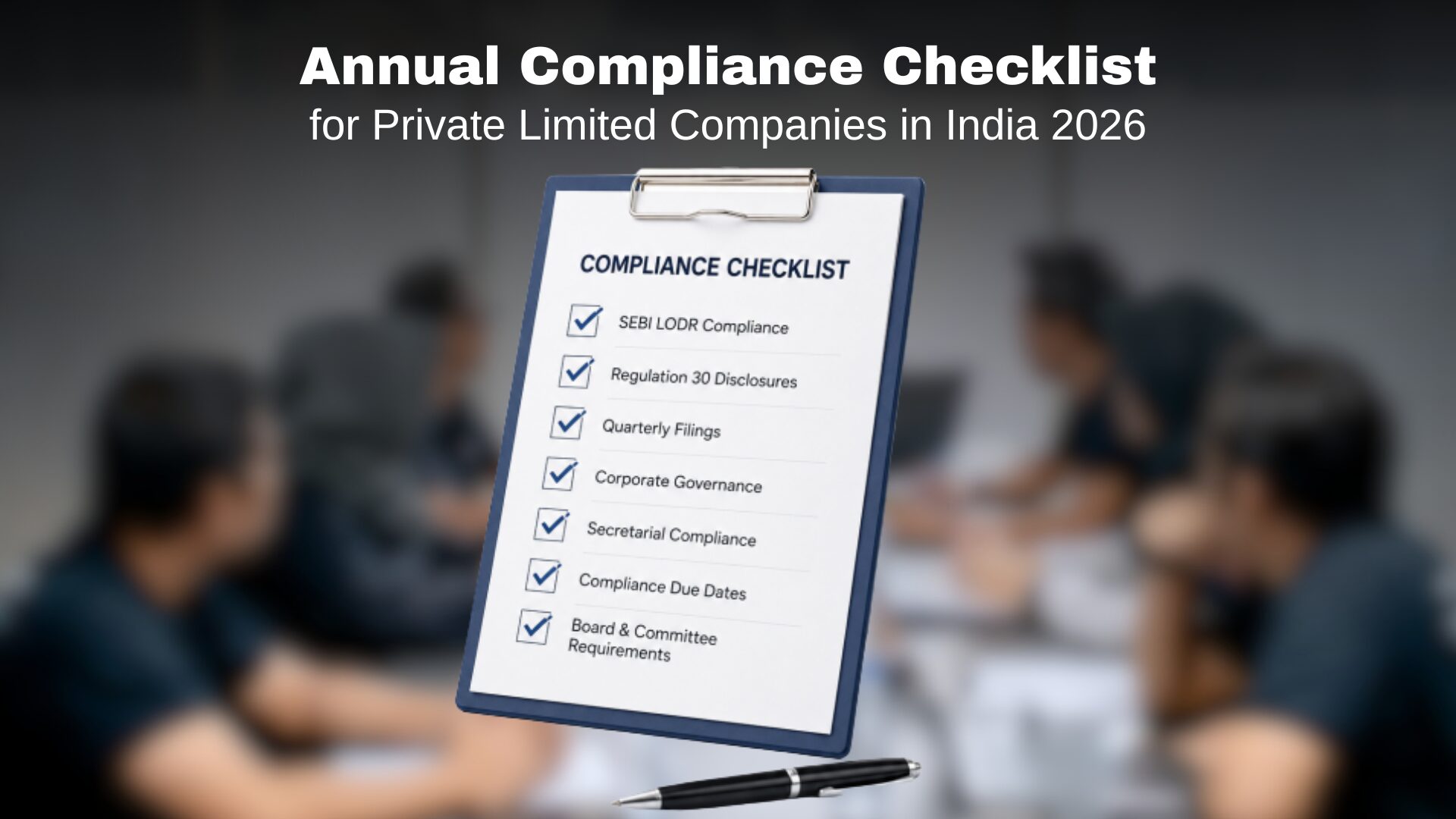
Missing a single statutory deadline in 2026 doesn’t just trigger an unforgiving ₹100-per-day penalty it can silently disqualify your board of directors and freeze your bank accounts overnight. With the Ministry of Corporate Affairs (MCA) utilizing advanced AI-driven scrutiny on the V3 portal, ignorance of the law is no longer an excuse.
What is the annual compliance for a private limited company in India? Annual compliance for a private limited company in India requires mandatory statutory filings with the Registrar of Companies (ROC) and Income Tax Department to maintain legal validity. For 2026, core requirements include holding an Annual General Meeting (AGM) by September 30, filing financial statements via Form AOC-4 within 30 days of the AGM, submitting the annual return (Form MGT-7/7A) within 60 days, and filing DIR-3 KYC and corporate income tax returns.
Table of Contents
Why Strict Adherence to Annual Compliance Matters in 2026
Founders often focus heavily on product and sales, leaving company compliance as an afterthought. However, the MCA has significantly tightened its regulatory framework. Failing to adhere to the company compliance checklist India standards carries severe, cascading consequences.
The real cost of missing these deadlines extends far beyond minor late fees:
- The ₹100/Day Penalty Trap: Under the Companies (Registration Offices and Fees) Rules, 2014, failing to file Form AOC-4 or Form MGT-7 attracts a strict ₹100 per day penalty for each form. A delay of just six months can cost your company upwards of ₹36,000 in late fees alone.
- Director Disqualification: Under Section 164(2) of the Companies Act, 2013, if a company fails to file financial statements or annual returns for three consecutive financial years, every director on the board is disqualified from acting as a director in any company for a period of five years.
- Company Strike-Off (Section 248): The ROC actively identifies and strikes off companies that fail to commence business or skip compliance filings for two consecutive financial years. Your “Active” status can turn into “Strike Off,” freezing all corporate bank assets.
- Loss of Brand Trust: Vendors, banks, and prospective investors routinely check MCA master data. A history of delayed compliance flags your business as a high-risk entity, jeopardizing loan approvals, government tenders, and venture capital funding.
Quick Reference: 2026 Compliance Deadlines & Penalties
Before diving into the detailed requirements, here is a quick-reference summary of the mandatory ROC filing 2026 deadlines for Financial Year 2025–2026 (assuming a standard April–March fiscal year).
| Compliance Requirement | Governing Form | Statutory Deadline for FY 2025-26 | Core Penalty for Default |
| Annual General Meeting | Physical / Virtual Meeting | September 30, 2026 | Up to ₹1,00,000 + ₹5,000/day |
| Financial Statements | Form AOC-4 | October 29, 2026 | ₹100 per day of delay |
| Annual Return | Form MGT-7 / MGT-7A | November 28, 2026 | ₹100 per day of delay |
| Auditor Appointment | Form ADT-1 | October 14, 2026 | Standard late filing fees apply |
| Director KYC | Form DIR-3 KYC (Web/E-form) | September 30, 2026 | ₹5,000 late fee; DIN deactivation |
| MSME Payments | MSME Form 1 (Half-yearly) | April 30 & October 31, 2026 | Fine up to ₹25,000 |
| Return of Deposits | Form DPT-3 | June 30, 2026 | Heavy penalties under Sec 73 |
| Income Tax Return | ITR-6 | October 31, 2026 (if audited) | ₹5,000 – ₹10,000 under Sec 234F |
The Master Annual Compliance Checklist for Private Limited Companies in India 2026
To ensure your business remains on the right side of the law, follow this authoritative breakdown of the annual compliance for private limited company India 2026.
1. Conducting the Annual General Meeting (AGM)
- Governing Section: Section 96 of the Companies Act, 2013.
- The Requirement: Every private limited company must hold an AGM to discuss the financials, declare dividends (if any), appoint auditors, and evaluate the director’s report. The maximum gap between two AGMs cannot exceed 15 months.
- The Deadline: On or before September 30, 2026, for the financial year ending March 31, 2026. (Note: For newly incorporated companies holding their first AGM, the deadline is 9 months from the end of the first financial year).
- The Penalty: If the company fails to hold the meeting, the company and every officer in default are punishable with a fine up to ₹1,00,000, and a further fine of ₹5,000 for every day the default continues.
2. Filing Financial Statements (Form AOC-4)
- Governing Section: Section 137 of the Companies Act, 2013.
- The Requirement: Form AOC-4 is used to file the company’s financial statements with the ROC. This is one of the most critical elements of AOC-4 filing. The form must include the Balance Sheet, Profit & Loss Account, Director’s Report, Auditor’s Report, and notice of the AGM.
- The Deadline: Within 30 days of holding the AGM. If the AGM is held on the last permissible date (Sept 30, 2026), the AOC-4 deadline is October 29, 2026.
- The Penalty: A strict, non-negotiable penalty of ₹100 per day of delay applies. Further, the company may face a penalty of ₹10,000, and directors could be penalized ₹10,000 plus ₹100/day up to ₹50,000.
3. Filing the Annual Return (Form MGT-7 / MGT-7A)
- Governing Section: Section 92 of the Companies Act, 2013.
- The Requirement: This form acts as a comprehensive summary of the company’s shareholding structure, changes in directorships, and debt details over the financial year.
- Form MGT-7A: Specifically designed for “Small Companies” (paid-up capital up to ₹4 Crore and turnover up to ₹40 Crore) and One Person Companies (OPCs).
- Form MGT-7: Used by all other private and public companies that do not meet the small company criteria.
- The Deadline: The MGT-7 deadline is 60 days from the date of the AGM. For an AGM held on September 30, 2026, this form must be filed by November 28, 2026.
- The Penalty: Similar to AOC-4, delayed filing attracts a penalty of ₹100 per day of default under Section 92(4).
4. Appointment or Re-appointment of Statutory Auditor (Form ADT-1)
- Governing Section: Section 139 of the Companies Act, 2013.
- The Requirement: Every company must appoint a practicing Chartered Accountant (CA) as its statutory auditor. For the first auditor, the Board of Directors appoints them within 30 days of incorporation. Subsequently, an auditor is appointed at the AGM for a tenure of five years. Form ADT-1 is the official intimation to the ROC of this appointment.
- The Deadline: Within 15 days from the date of the AGM. If appointed at the Sept 30, 2026 AGM, the ADT-1 must be filed by October 14, 2026.
- The Penalty: Standard late filing fees based on the number of days delayed (ranging from 2 to 12 times the normal fee).
5. Director KYC Verification (Form DIR-3 KYC)
- Governing Rule: Rule 12A of the Companies (Appointment and Qualification of Directors) Rules, 2014.
- The Requirement: Every individual holding a Director Identification Number (DIN) as of March 31 of a financial year must submit their KYC details to the MCA. If no details have changed from the previous year, the director can simply verify via a web-based OTP (DIR-3 KYC Web). If details (like a passport number or phone number) have changed, the full e-Form DIR-3 KYC must be filed with CA/CS certification.
- The Deadline: September 30, 2026.
- The Penalty: A flat late fee of ₹5,000 is imposed. Crucially, the MCA will mark the DIN as “Deactivated due to non-filing of DIR-3 KYC,” preventing the director from signing any MCA forms or acting in their capacity until the fee is paid.
6. MSME Half-Yearly Return (Form MSME-1)
- Governing Section: Section 405 of the Companies Act, 2013.
- The Requirement: If your company buys goods or services from micro and small enterprises (registered under the MSME Act) and your payments to them are delayed beyond 45 days, you must declare these outstanding dues to the ROC via MSME Form 1.
- The Deadline: Filed twice a year.
- For the period April to September: October 31, 2026.
- For the period October to March: April 30, 2026.
- The Penalty: Defaulting on this form can lead to a fine of up to ₹25,000 for the company, and directors may face imprisonment up to 6 months or a fine between ₹25,000 and ₹3,00,000.
7. Return of Deposits (Form DPT-3)
- Governing Rule: Rule 16 of the Companies (Acceptance of Deposits) Rules, 2014.
- The Requirement: All private limited companies must file this form to disclose details of outstanding loans, advances, or deposits held by the company as of March 31. This includes loans from directors, banks, and inter-corporate deposits.
- The Deadline: June 30, 2026.
- The Penalty: Under Section 73, non-compliance can attract immense penalties, ranging from ₹1 Crore to ₹10 Crores, and directors can face imprisonment of up to 7 years if they illegally accepted deposits without disclosure.
8. Corporate Income Tax Return (ITR-6)
- Governing Section: Income Tax Act, 1961.
- The Requirement: All private limited companies must file their corporate tax returns (ITR-6) electronically.
- The Deadline: * For companies requiring a tax audit: October 31, 2026.
- For companies not requiring a tax audit (rare for Pvt Ltd due to statutory audit requirements) or where transfer pricing applies, deadlines may shift, but October 31 remains standard for most.
- The Penalty: Under Section 234F, late filing attracts a penalty of ₹5,000 (or ₹1,000 if total income is below ₹5 Lakhs), alongside interest under Section 234A. Losses cannot be carried forward if the return is filed late.
9. GST Annual Return (GSTR-9)
- The Requirement: If your company is GST registered and crosses the turnover threshold (usually ₹2 Crores for GSTR-9 and ₹5 Crores for the GSTR-9C reconciliation statement), you must file an annual comprehensive GST return.
- The Deadline: December 31 of the succeeding financial year (e.g., Dec 31, 2026, for FY 2025-26).
- The Penalty: ₹200 per day (₹100 CGST + ₹100 SGST) subject to a maximum of 0.25% of turnover in the state or union territory.
Event-Based Compliance Reminders
Beyond standard annual compliance, private companies must file specific forms when triggering major corporate events. Overlooking these is a common trap for scaling startups. Keep these on your radar:
- Change in Directors (DIR-12): Whenever a director is appointed, resigns, or is removed, Form DIR-12 must be filed within 30 days of the resolution.
- Change in Registered Office (INC-22): Shifting the official address of the company requires filing Form INC-22 within 30 days of the change. (Note: Shifting between states requires a much more complex process involving the Regional Director).
- Increase in Authorized Capital (SH-7): Raising funds often requires increasing the authorized share capital. Form SH-7 must be filed within 30 days of passing the ordinary resolution.
- Allotment of Shares (PAS-3): When new shares are issued to investors or promoters, the Return of Allotment (PAS-3) must be filed within 30 days.
- Creation or Modification of Charges (CHG-1): Taking a business loan from a bank that requires collateral? You must file CHG-1 within 30 days to register the charge against the company’s assets.
Severe Consequences of Non-Compliance
Many new founders ask their CA: “Can we just delay this until next year to save money?” The answer is a resounding no. Here is exactly what goes wrong when you neglect compliance:
- Financial Hemorrhaging: The ₹100/day penalty for late ROC filings is cumulative and uncapped. Delaying AOC-4 and MGT-7 by one year will cost the company a minimum of ₹73,000 just in late fees, excluding professional CA fees to untangle the mess.
- Director Paralysis: A deactivated DIN (due to missing DIR-3 KYC) or a Section 164(2) disqualification means you cannot sign documents, join the board of another promising startup, or legally represent your company.
- Business Operations Freeze: Once the ROC initiates strike-off proceedings for failure to file returns, your bank will automatically freeze all corporate accounts. You will be unable to pay employees, vendors, or rent until the company is legally revived via the NCLT (National Company Law Tribunal), a process taking 6-12 months and costing lakhs in legal fees.
- Investor Rejection: Venture capitalists and angel investors conduct rigorous due diligence. A cluttered MCA dashboard showing pending compliances or unpaid penalties is a massive red flag that will kill a funding deal instantly.
Frequently Asked Questions (FAQ)
Here are the most common questions founders ask our experts at TrustLink India regarding corporate compliance.
Q: What is the last date for ROC filing for FY 2025-26? A: The main ROC filing deadlines for FY 2025-26 are October 29, 2026, for Form AOC-4 (financial statements) and November 28, 2026, for Form MGT-7/7A (annual return), assuming the Annual General Meeting is held on the final allowable date of September 30, 2026.
Q: What happens if a private limited company does not file an annual return? A: If a company fails to file its annual return (MGT-7), it attracts a non-negotiable penalty of ₹100 per day of delay. If the failure continues for three consecutive years, the company risks being struck off the ROC register, and its directors will be disqualified from holding board positions for five years.
Q: Is an audit compulsory for a private limited company in India? A: Yes, a statutory audit by a practicing Chartered Accountant is absolutely mandatory for every private limited company in India, regardless of its turnover, profit, or whether it has conducted any business activity during the year.
Q: What is the difference between Form MGT-7 and MGT-7A? A: Form MGT-7A is an abbreviated annual return meant specifically for “Small Companies” and One Person Companies (OPCs), requiring less disclosure. Form MGT-7 is the comprehensive annual return used by standard private and public companies that do not fit the small company definition.
Q: Can a struck-off company be revived? A: Yes, a struck-off company can be revived by filing an appeal with the National Company Law Tribunal (NCLT) within three years (or up to twenty years in certain cases) of the strike-off order. However, the process is highly complex, expensive, and requires paying all pending penalties and proving the company was operational.
Stay Compliant. Stay Protected. Let TrustLink India Handle the Rest.
Navigating the annual compliance for private limited company India 2026 landscape does not have to be a source of anxiety. Between tracking shifting MCA V3 portal requirements, managing auditor coordination, and ensuring you don’t trigger the ₹100-per-day penalty traps, your time is better spent growing your business.
At TrustLink India, our team of senior Chartered Accountants and Company Secretaries based in Kolkata specializes in end-to-end ROC and tax compliance. We handle everything from drafting board resolutions and managing AGM documentation to filing AOC-4, MGT-7, and your corporate tax returns—ensuring 100% accuracy and zero missed deadlines.
Don’t wait for a compliance notice to arrive in your inbox. Contact TrustLink India today for a complete corporate compliance health check, and let us safeguard your company’s legal standing while you focus on scaling your vision.
(Note: The MCA updates rules periodically. Always consult your CA or a TrustLink India professional before making legal decisions based on this guide.)